Some reflections on AI and Creativity
I have the weird habit of sometimes opening Linkedin and looking at my own profile. I think it’s probably some subconscious thing, similar to what motivates us to look at ourselves in the mirror, searching for imperfections, or just trying to keep an updated view of ourselves. Maybe it’s because I look at my phone too much. I don’t know.
Anyway, in one of those sporadic moments (this Sunday morning, to be precise), I glanced at my own profile text and remembered a conversation I had with my girlfriend this week about what a CV profile should say. Out of curiosity (and habit), I couldn’t help thinking to myself: What would Karpathy do? What does Karpathy have in his Linkedin profile? So I typed “karpathy” in the search bar, but when I was about to click on his profile, I misclicked and searched the term instead, allowing Linkedin to show me the “closest” thing to “karpathy” on the platform.

|
| Figure 1. What would Andrej Karpathy do? |
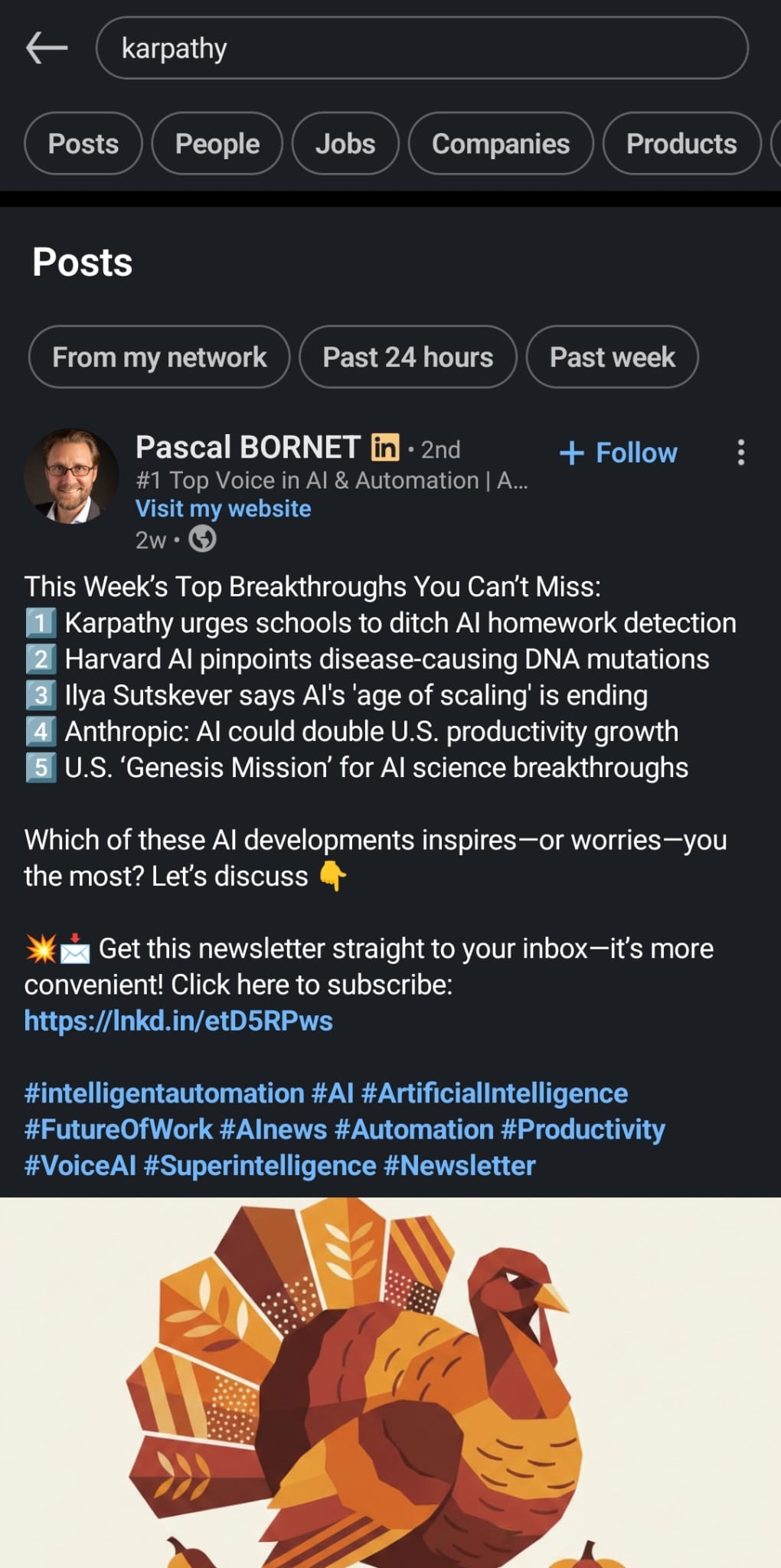
To my honest surprise, the top result was not Andrej Karpathy’s profile (could it be because he doesn’t post on Linkedin?). Instead, it was a post from an AI influencer.
Following my curiosity, I opened his profile to see what made his post the closest thing to “karpathy” (I am always on an almost “obsessive” mission to find interesting people and papers in the AI space, so I had to check). Inside, I saw he had 1.5M followers which could explain the recommendation. That shifted my curiosity: I decided to investigate how a “top voice” in the AI space actually writes, especially now that I’m dedicating some time to writing myself.
Reading one of the posts, I couldn’t help but notice common patterns of AI writing:
- Using a question in the middle of the post to catch the reader’s attention
- Phrases like “The more powerful the blablabla, the more human the blublublu…”
- Emojis or uncommon UTF-8 characters
|
| Figure 2. Closest post to "karpathy" according to Linkedin search |
Now, while my first intuition was that AI had played a role here, I am not a native English speaker, nor am I an expert on the topic. In fact, there is an interesting conversation to be had about how LLMs are influencing the way we speak. For instance, I have noticed myself using terms like “delve” and “showcase” more frequently, terms usually associated with AI writing, even when I am not using an LLM (Wikipedia has an interesting article about signs of AI writing, if you’re curious).
That said, I don’t believe that using LLMs means everything written or created will be slop. Nor do I think LLMs are “incapable” of creating creative or high-quality content, though there is certainly a discussion to be had about it (Jessica Hullman has an interesting blog post on the matter).
But I am slightly digressing. Coming back to that Linkedin post, I think it reignited an internal questioning I have been wrestling with all year about creativity and “craft”, especially with current AI advancements. Why do I build software? Why do I paint miniatures? Why spend a Sunday writing this post when an LLM could generate a “passable” version in seconds? To me, it boils down to two things: understanding why I create in the first place, and figuring out how to preserve myself in the resulting creation.
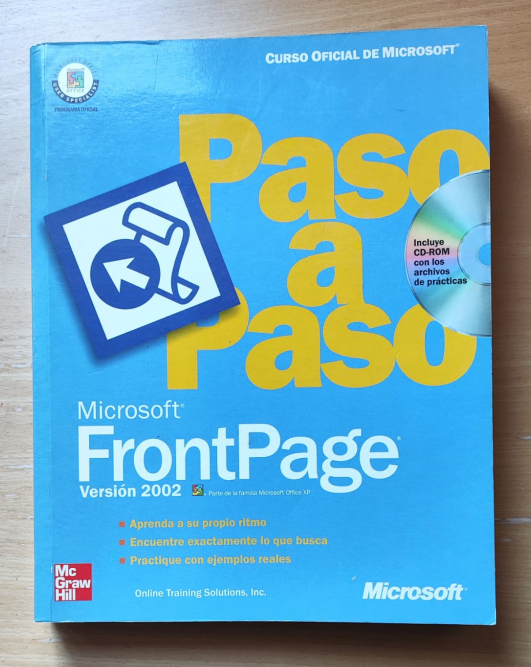
Thinking about all of this made me remember something I built long before LLMs existed: my first webpage, made back in 2006 for the game Metroid Prime Hunters. A page built using Microsoft FrontPage that, if I recall correctly, was hosted by Telecable, my home’s internet provider when I was a kid. I still remember the feeling of joy when I got it to work and shared the webpage with my friends.
Back then, there were no LLMs, not even StackOverflow, so I remember reading through the book and dedicating part of my weekends to learning and building through trial and error. I remember searching for the “coolest” images and GIFs on the internet, like the legendary “Dancing Banana GIF”:  .
.
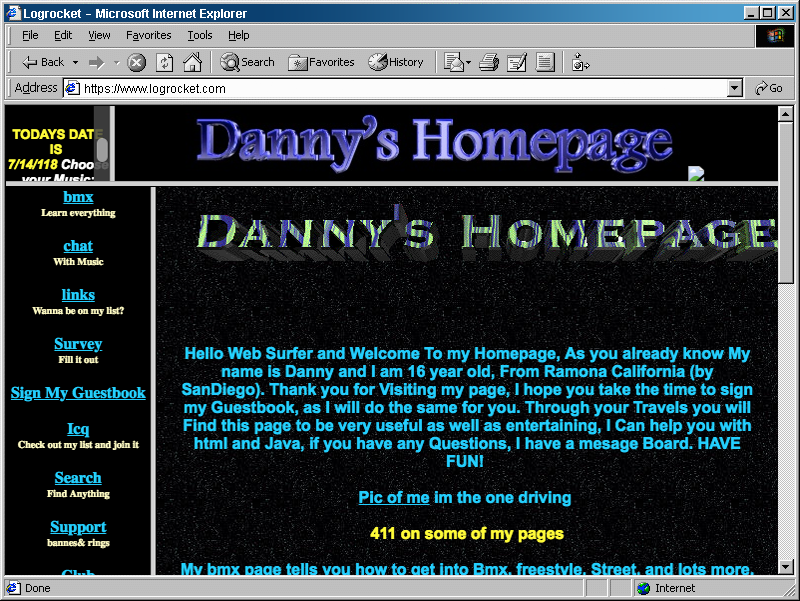
Unfortunately, I didn’t save a copy of that webpage, but it was something similar to the following:
|
|
| Figure 3. A similar kind of webpage to the one I created when I was young (left) and my father's copy of Microsoft FrontPage (2002), which I used to build it (right) | |
When I think about that webpage, the miniatures I paint, these blog posts, and even the software I write every day in my job, I realize that what motivates me is creating something that is not only cool, but that also endures (even if just a little) and keeps a part of me in it.
This desire for endurance might be why “AI-accelerated” content often bothers me. It gives off a “fast-food” feeling, where things are created with no intention of lasting. It might be code without proper architecture or content designed solely to optimize for engagement algorithms and rise higher in the feed. On this topic, I remembered a conversation between Jeremy Howard and Chris Lattner about building software that lasts in an age when “everyone is vibe-coding their way through problems”.
So yeah, I think my main reflection here is about how we can use AI as a tool without losing ourselves in the process. I have been using LLMs to review my text and code since Chat-GPT was released in 2022. It is a learning process, but if used correctly, I don’t think using AI makes the result less “mine”.
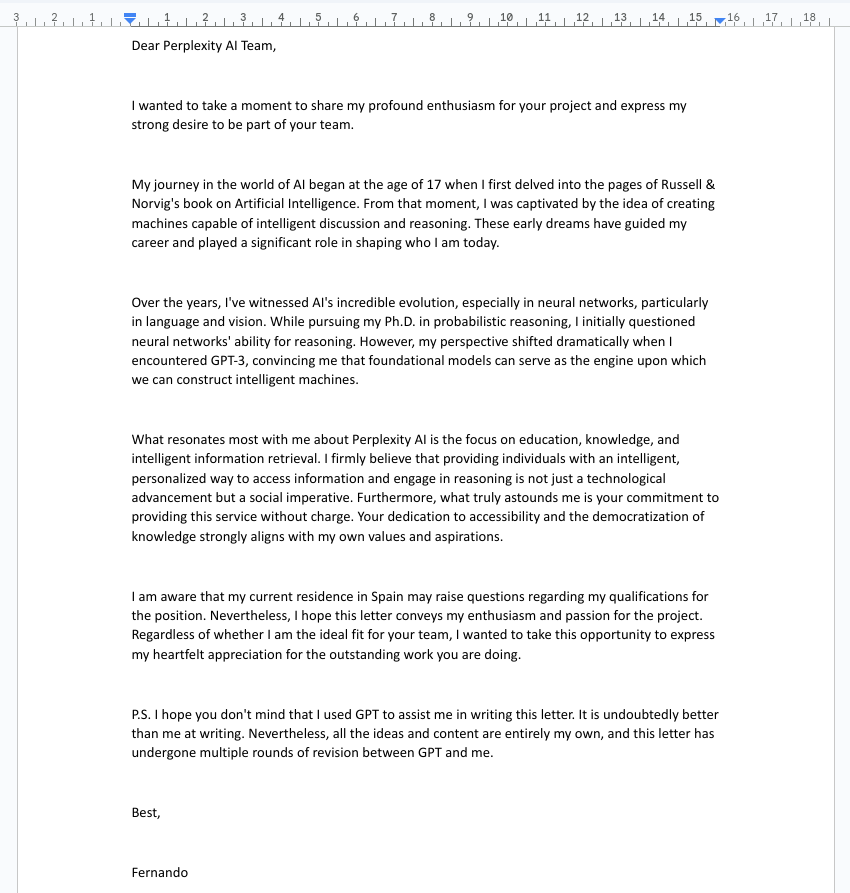
As an example, here’s a cover letter I sent to Perplexity back in 2023 (I don’t think they’ll mind sharing it, they never replied). At the time, using an LLM for this felt almost novel to me, an experiment at integrating this new technology into my daily life. Reading the letter now, I still recognize my voice in it, even if I used an LLM to co-write it.
|
| Figure 4. Cover letter I wrote back in 2023 for an application to Perplexity AI |
One last analogy (I promise). I think current LLMs present a problem similar to the Ring of Gyges (here is a nice video from TED Ed that I found the other day, which motivated the example). In Plato’s story, the ring grants its wearer invisibility, and with it, the temptation to act without consequences. I think something similar happens with LLMs: we get a nice powerup and assume no one will notice. But even if that were true (and it’s doubtful, since remaining unnoticed is hard when everyone knows you have “the ring”), the real danger isn’t getting caught. It’s the risk of corruption, of slowly losing part of ourselves in the process.
For all these reasons, I like to remind myself why I do what I do. And I keep coming back to the same answer: I want to create something interesting that lasts. I write posts not just to share, but to organize and reflect on my ideas. I paint miniatures because the result is cool, tangible, and lasting. As for studying and working in AI, it helps me understand myself better as a human being and, honestly, I still dream of creating intelligent beings. With that clarity, LLMs, and AI in general, become useful tools that help me develop my “craft”, serving my goals rather than eroding my sense of self.
So, what about the original question? What does Karpathy have in his Linkedin profile? Well, his profile simply has the URL of his personal webpage, which probably makes sense for someone of his caliber. I am not sure if I should do the same, to be honest. Nevertheless, that small missclick finally pushed me to organize these thoughts. It also reminded me of what I wrote in that old cover letter. Now, hopefully, I can make a cool and lasting contribution, if not to AI itself, then at least with it.